The Mechanics, Infrastructure, and Integration of Modern Solar Energy Systems
The global transition toward renewable energy has elevated solar technology from a niche alternative to a primary pillar of modern power generation grids. Solar energy represents the most abundant energy resource on Earth, delivering more power to the planet surface in a single hour than human civilization consumes in an entire year. Harnessing this raw energy cleanly and efficiently requires a sophisticated combination of materials science, electrical engineering, and advanced grid infrastructure.
For homeowners, industrial enterprises, and utility operators, transitioning to solar requires a comprehensive understanding of how light is converted into stable electricity. This process relies on a complex chain of components engineered to capture, invert, manage, and store electrical current under diverse environmental conditions.
The Science of Solar Conversion: How Photovoltaics Work
At the core of standard solar technology is the photovoltaic cell, a solid-state electronic device that converts sunlight directly into electrical energy without any moving parts. This conversion relies on the quantum mechanical phenomenon known as the photovoltaic effect.
The Silicon Semiconductor Layer
Most modern solar cells are constructed from silicon, a highly abundant metalloid semiconductor. To generate an electrical current, the silicon must be altered through a process called doping, which introduces specific impurities to create a permanent electrical field.
-
The N-Type Layer: The top layer of the silicon cell is doped with phosphorus, an element that possesses more valence electrons than silicon. This creates an abundance of free, negatively charged electrons.
-
The P-Type Layer: The bottom layer is doped with boron, which has fewer valence electrons than silicon. This leaves an abundance of electron vacancies, often referred to as holes, creating a positive charge.
-
The PN Junction: The boundary where these two layers meet is called the PN junction. The interaction between the opposing charges creates a permanent internal electric field that forces free electrons to move in a single, specific direction.
Photon Infiltration and Electron Flow
When sunlight strikes the surface of the solar panel, it releases packets of energy called photons.
-
As these photons penetrate the silicon cell, they collide with silicon atoms, transferring their energy to the bound electrons.
-
If the energy of the photon matches or exceeds the bandgap energy of the semiconductor material, the electron is knocked loose from its atomic bond, creating a free electron and a corresponding hole.
-
The internal electric field at the PN junction acts as a one-way valve, drawing the newly freed, negatively charged electrons toward the N-type layer and pushing the positive holes toward the P-type layer.
-
Metal contact grids on the top and bottom of the cell collect these moving electrons and route them into an external circuit, generating a stream of direct current electricity.
Primary System Architectures: Grid-Tied, Off-Grid, and Hybrid
Solar energy installations are engineered into specific configurations depending on the accessibility of the local utility grid and the operational goals of the property owner.
Grid-Tied Solar Configurations
Grid-tied systems are the most common installations in urban and suburban areas. These systems remain physically connected to the local utility infrastructure.
-
Operational Simplicity: Electricity generated by the solar panels flows directly into the home electrical panel. If the solar array produces less power than the home requires, such as during heavy rain or at night, the system automatically draws the deficit from the utility grid.
-
Net Metering Infrastructure: When the solar panels generate more electricity than the household consumes during peak daylight hours, the excess energy is fed backward through a bi-directional smart meter into the utility grid. Property owners receive financial credits from their utility provider for this exported energy.
-
Safety Shutdown Protocols: Grid-tied systems feature an automatic rapid-shutdown mechanism. If a regional blackout occurs, the solar inverter automatically deactivates the array to prevent electricity from feeding back into the lines, protecting utility linemen who may be repairing the grid.
Off-Grid Solar Networks
Off-grid systems are entirely isolated from the commercial electrical grid, making them necessary for remote cabins, agricultural water pumping stations, and wilderness research facilities.
-
Battery Bank Dependence: Because there is no utility grid to act as a safety net, off-grid systems must incorporate massive battery storage networks to maintain power during the night and prolonged periods of overcast weather.
-
Generator Redundancy: Most off-grid architectures incorporate a backup fossil-fuel or biofuel generator programmed to start automatically if the battery bank drops below a critical state-of-charge threshold.
Hybrid Solar Systems
Hybrid systems combine the structural security of a grid connection with the localized energy independence of a battery bank.
-
Dynamic Load Balancing: Under normal operation, the system powers the home and charges a localized battery bank using solar energy.
-
Emergency Back-Up: If the regional utility grid suffers a blackout, the hybrid inverter disconnects from the grid within milliseconds and establishes a localized microgrid powered by the battery bank and active solar generation, ensuring continuous power to critical circuits.
Essential Balance of System Components
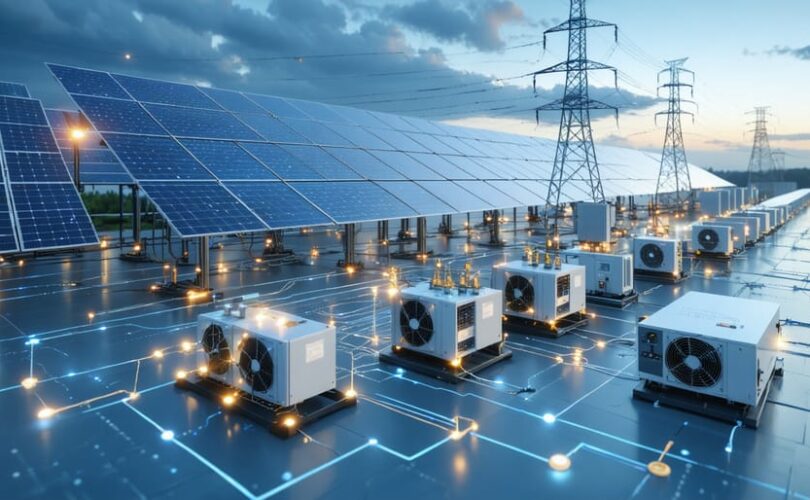
While solar panels capture the spotlight, they cannot function without an accompanying network of electronic and mechanical hardware collectively known as the Balance of System.
Inverter Technologies
Solar panels naturally generate direct current electricity, where electrons flow continuously in a single direction. However, residential appliances and the broader utility grid operate on alternating current electricity, where the current periodically reverses direction. Inverters perform this critical translation.
-
String Inverters: A traditional configuration where a series of solar panels are linked together in a single string connected to a single large inverter. While cost-effective, if one panel in the string suffers from shading or debris, the power output of the entire string drops to match that lowest-performing panel.
-
Microinverters: Small, localized inverters mounted beneath every individual solar panel. This architecture isolates each panel, ensuring that shading on a single module does not degrade the performance of the rest of the array. Microinverters also convert power to alternating current right at the panel level, minimizing voltage drops over long wire runs.
Charge Controllers
In systems incorporating battery storage, charge controllers act as automated gatekeepers between the solar array and the battery cells.
-
They regulate the incoming voltage and current to prevent overcharging, which can permanently ruin battery chemistry or cause thermal runaway fires.
-
Maximum Power Point Tracking: Modern charge controllers utilize tracking algorithms to constantly optimize the voltage output of the solar panels, ensuring the battery receives the maximum possible wattage regardless of shifting cloud cover or temperature changes.
Maintenance, Degradation, and Environmental Resilience
Solar panels are engineered to withstand extreme environmental exposure, including hail impacts, high winds, and severe temperature fluctuations. However, like all electronic assets, they require routine oversight to ensure optimal performance over their multi-decade lifespan.
Mitigating Shading and Soiling Effects
Because solar panels are connected in electrical circuits, any physical obstruction that blocks light from reaching the silicon cells causes an immediate reduction in power output.
-
Soiling: The accumulation of airborne dust, pollen, bird droppings, and industrial soot on the protective glass surface is known as soiling. In arid regions with infrequent rainfall, severe soiling can degrade solar output by up to 20 percent. Periodic cleaning with distilled water and soft brushes is required to restore efficiency.
-
Shading Dynamics: Even partial shading from a nearby tree branch or chimney can trigger an internal resistance spike within a solar cell, causing it to heat up. Modern panels incorporate bypass diodes to redirect current around shaded sections, minimizing performance drops and preventing localized hot-spot damage.
Natural Degradation Rates
Solar panels slowly lose efficiency over time due to a variety of environmental factors, including ultraviolet light exposure and thermal cycling.
-
The average degradation rate for standard silicon solar panels ranges from 0.5 percent to 0.8 percent per year.
-
This means a tier-one solar panel will typically operate at 80 to 85 percent of its original rated capacity after 25 years of continuous outdoor operation.
-
Manufacturers secure these lifespans by enclosing the sensitive silicon cells within layers of ethylene-vinyl acetate encapsulant, heavy-duty tempered glass, and a rigid anodized aluminum frame.
Frequently Asked Questions
What is the specific operational difference between monocrystalline and polycrystalline solar panels?
Monocrystalline solar panels are manufactured from a single, high-purity silicon crystal structure. This uniform structure allows electrons to move with less resistance, yielding higher operational efficiencies, typically between 19 and 23 percent. Visually, they feature a uniform, dark black appearance. Polycrystalline panels are created by melting multiple silicon crystals together in a mold. This creates internal boundaries that restrict electron movement, lowering efficiency to between 15 and 17 percent. Polycrystalline panels are recognizable by their fragmented, bright blue appearance.
How does temperature affect the electrical efficiency of a photovoltaic panel?
Counterintuitively, solar panels perform less efficiently in extreme ambient heat. Solar panels are electronic devices, and as their temperature rises, the electrical resistance within the semiconductor material increases. This resistance causes a drop in voltage output, which ultimately reduces the total wattage generated. Manufacturers publish a specific metric called the temperature coefficient, which dictates exactly how much efficiency a panel loses for every degree the temperature rises above 25 degrees Celsius.
What is the purpose of anti-reflective coatings on modern solar panel glass?
Silicon naturally possesses a high refractive index, meaning it tends to reflect a substantial percentage of incoming sunlight away from its surface rather than absorbing it. To maximize light capture, manufacturers apply an ultra-thin layer of anti-reflective material, such as silicon nitride, directly to the glass and silicon surfaces. This coating reduces surface reflection to less than 2 percent, forcing more photons to pass directly into the semiconductor layers where they can liberate electrons.
Why do some solar systems require rapid shutdown devices, and how do they function?
Rapid shutdown is a safety standard mandated by the National Electrical Code to protect emergency first responders and firefighters. While an inverter can turn off home power, the solar panels themselves will continue to generate high-voltage direct current electricity as long as the sun is shining. A rapid shutdown system utilizes localized switchgear at each individual panel to instantly de-energize the entire rooftop array down to safe voltage levels within seconds of a primary power cutoff.
What is the difference between a solar panel power tolerance rating and its nameplate capacity?
The nameplate capacity is the theoretical wattage a solar panel produces under ideal laboratory conditions, known as Standard Test Conditions. However, real-world manufacturing processes introduce minor variations between individual panels. The power tolerance rating defines the acceptable variance range for that specific panel model. For example, a 400-watt panel with a positive power tolerance of 0 to plus 5 percent is guaranteed to produce between 400 and 420 watts under standard test settings, ensuring it will never underperform its primary rating out of the box.
How do bifacial solar panels generate more electricity than standard monofacial designs?
Bifacial solar panels are engineered with transparent backsheets or dual-sided glass configurations that allow the silicon cells to absorb light from both the front and rear surfaces. While the front face absorbs direct sunlight, the rear face captures indirect light reflected off the surrounding ground, roofs, or nearby structures. This reflected light is known as the albedo effect. When installed over highly reflective surfaces like light-colored gravel, concrete, or snow, bifacial panels can increase total energy yields by up to 30 percent compared to standard single-sided panels.